Publish it once, then send it to the people it is for
News and blog posts, email newsletters, photo albums by era, notable alumni and a timeline of the institution itself. One admin panel, your own domain, one licence.
Your archive is why alumni visit a second time, and why your site turns up in a search for the school's history.
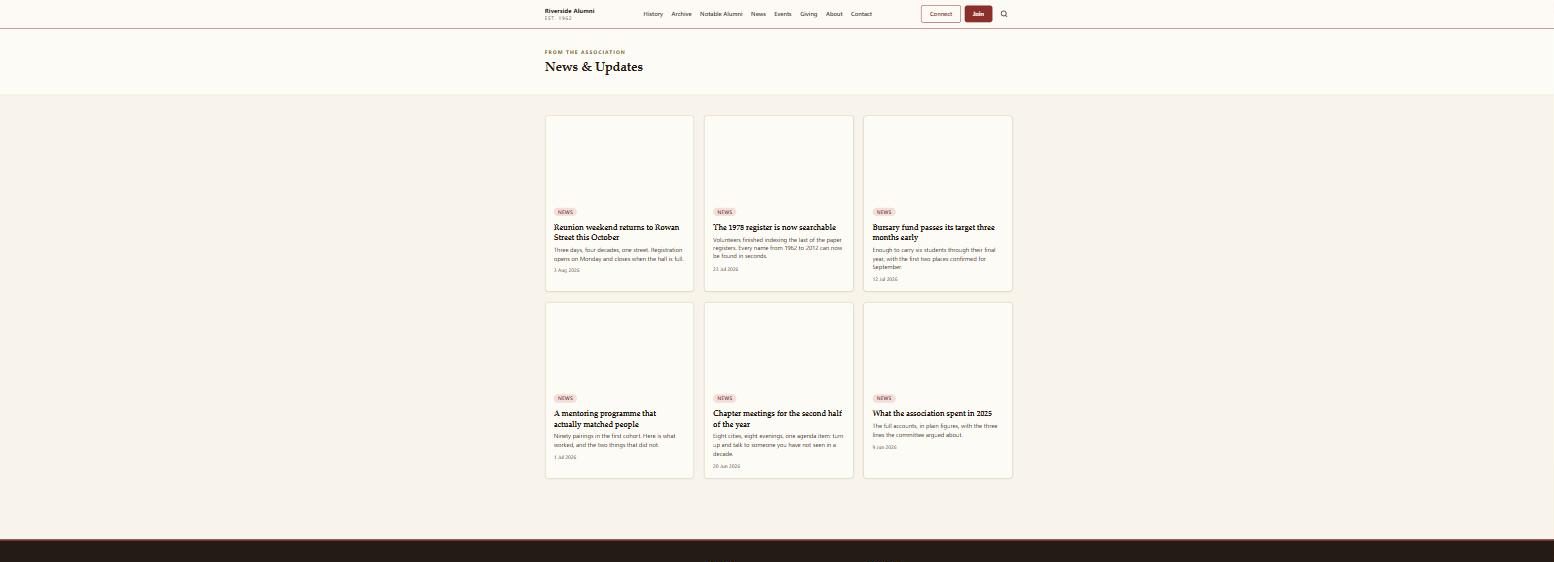
A news page that looks like a publication
Cover images, dates, a real page for each post and an index that keeps its order. It reads like a magazine rather than a noticeboard, which is what makes an alumnus click a second story.
A real install with real articles in it. There is no public demo site yet, so screenshots are the honest way to show the product.
More screenshotsFive things to publish, one place to write them
Alumni communications are not one job. They are a monthly job, a quarterly job and a permanent job, and each needs different tools.
News and blog
Announcements, obituaries, appointments, appeal updates and long form pieces. Each post has its own page and its own SEO fields, so the story about your 1974 first XI can be found by someone who was in it.
Newsletters to your members
Write the email, choose who it goes to and send it from the same panel that holds the member list. No exporting a CSV to a tool that charges by contact and is out of date within a month.
Photo albums by era
Sports days, prize givings and reunions, grouped by decade so alumni can find the year they were there.
Notable alumni
A proper page for the graduates you are proud of, often the most visited part of an alumni site.
Institution timeline
Founding, moves, mergers and milestones, kept as a page rather than a PDF in a drawer.
A publishing rhythm one person can keep
Alumni sites do not fail because the software was wrong. They fail because month four arrives and nobody has written anything since launch.
The realistic cadence
- One news post a month. Two hundred words is enough: an appointment, an obituary, a reunion write-up, a bursary result.
- One newsletter a quarter, built from posts you already wrote. If the newsletter is the writing job, it will not get done.
- One archive push a year. Scan a box of photographs, put them in an album by decade, watch which years come back to look.
How the pieces feed each other
The reunion event gets a news post. The post goes in the newsletter. The newsletter drives RSVPs. Photographs become an album, the album becomes next year's announcement, and the appeal in the middle links to your giving page. Because it is one system on one domain, none of those links break when a subscription lapses or a staff member leaves.
The part that pays off slowly
The archive is the quiet asset. Notable alumni pages, the timeline and albums by era are what a search engine indexes and what a former pupil finds at eleven at night looking for their old class. Those visits become registrations. Most alumni platforms treat history as decoration. For a school with a hundred years behind it, it is the strongest content you own.
What alumni open, and what they ignore
Reliably read
- Obituaries and tributes
- Reunion dates and photographs
- Appointments and achievements
- Old photographs of their own year
- Named bursary and appeal results
Worth the effort
- Interviews with alumni about their work
- The institution's own history
- Notable alumni profiles
- Class notes gathered from a year group
Usually ignored
- Long messages from the head
- Newsletters with no photographs
- Anything sent more than monthly
- Appeals with no specific target
News and newsletter questions
Can we send to one batch year only?
Yes, and you should. Batch year is a structural field on every member, so a message about the 1998 reunion goes to 1998 rather than to everybody.
Segmented, less frequent email is the difference between a list that opens your messages and one that mutes you.
Do we still need an email marketing account?
For a few hundred members, no. For several thousand, keep a proper sending service and point AlumDeck at it, because shared hosting will throttle you.
Either way the member list stays in your own database rather than duplicated into a tool that charges per contact.
Is the blog good for search visibility?
Each post has its own page and its own SEO title and description, edited in the admin panel. That is the honest extent of it: real pages, editable meta, clean URLs.
The rest is writing things people search for, which is your job and not a feature anyone can sell you.
Are galleries and history extra modules?
No. Albums, notable alumni and the timeline are in the same $49 licence, and each can be switched off if you do not want it. See pricing.
Your alumni news, on infrastructure you control
News, newsletters, galleries, notable alumni and your institution's timeline, in the same one-time $49 licence as the directory and events.
Migrating an old newsletter list? Email hello@alumdeck.com and we will talk it through.