The whole alumni programme, on infrastructure you control
An alumni office is usually two or three people, a student assistant in exam season, and a budget that competes with the convocation catering. AlumDeck gives you the directory, mentoring, giving, events and news for one $49 licence per installation, with no cap on alumni records or staff accounts.
PHP 8.2 and MySQL. Your IT team will recognise a standard Laravel application with a normal file layout.
What alumni software asks a university for
Published figures where a vendor publishes one, and clearly labelled estimates where they do not. Only two of the twelve platforms we researched publish a self-serve price at all.
Two staff, forty thousand records, and a budget that is mostly catering
The alumni relations office at most institutions is smaller than software vendors assume. Two or three people, sometimes one, often with placement or communications duties attached.
That office is measured on turnout at convocation, on the annual fund, and on how many final-year students got a mentor. It is not measured on how well it negotiated a renewal, so the pricing model matters more than the feature list: it decides what you are allowed to do.
Per-record pricing punishes the exact behaviour you want, which is holding every alumnus you can trace. Seat pricing makes you ration admin logins between the placement cell, the department coordinators and the association secretary.
Unlimited is the point, not a marketing word
AlumDeck has no member limit, no admin seat limit and no tier that holds back the module you need. Add every batch since the institution opened, and give the placement officer, the department coordinators and the association secretary their own accounts. The price does not move, because there is only one price.
What self-hosting changes for procurement, and what it does not
A hosted platform arrives on your data protection officer's desk as a set of questions: where does alumni data live, which sub-processors touch it, what happens when it crosses a border. A self-hosted install answers those the way your student portal already answers them.
What it does not answer is who patches the server, and IT will ask that in the first meeting. The right time for that conversation is before the purchase.
Mentoring, giving, events and the archive, in one licence
Everything below is included. There is no add-on store and no enterprise tier holding back the module your director asked for.
Mentoring that does not burn out your volunteers
Match final-year students and younger alumni to mentors, with capacity limits so one willing senior alumnus does not get twelve requests in a week and quietly stop replying. That cap is the difference between a mentoring programme and a mentoring announcement.
Giving pages and campaign tracking
Branded donation pages for the annual fund, a scholarship appeal or a building campaign. No platform percentage comes out of what you raise, because AlumDeck is software on your server rather than an intermediary.
Convocation, reunions, chapters
Events with RSVPs, capacity limits and exportable attendance, for the batch reunion, the city chapter dinner and the annual general meeting.
A directory that survives forty batches
Search by name, batch year, city, country, profession and employer. That is how a placement cell finds an alumnus in the right industry, and how an alumnus finds someone in the right city.
A job board that stays internal
Alumni post roles and final years read them, inside the members area rather than on the open web.
Notable alumni, timeline and archive
The pages your prospectus, accreditation file and ranking submission all ask for: notable alumni, the institution timeline, and photo albums by era.
News, newsletters and committee pages
Publish a story once and email it to one batch or to everybody from the same admin panel. Committee and office bearer pages are built in, so the association side of the house has somewhere official to live.
Your alumni section is also a recruitment page
Prospective students and their parents read the alumni pages, and so do accreditation panels. AlumDeck publishes news, events, notable alumni and the institution timeline as a real public website, with the directory, profiles, mentoring and job board behind the login.
Screenshots here come from a running install configured as a college alumni association, with real content in it rather than placeholder blocks.
See the screenshot tour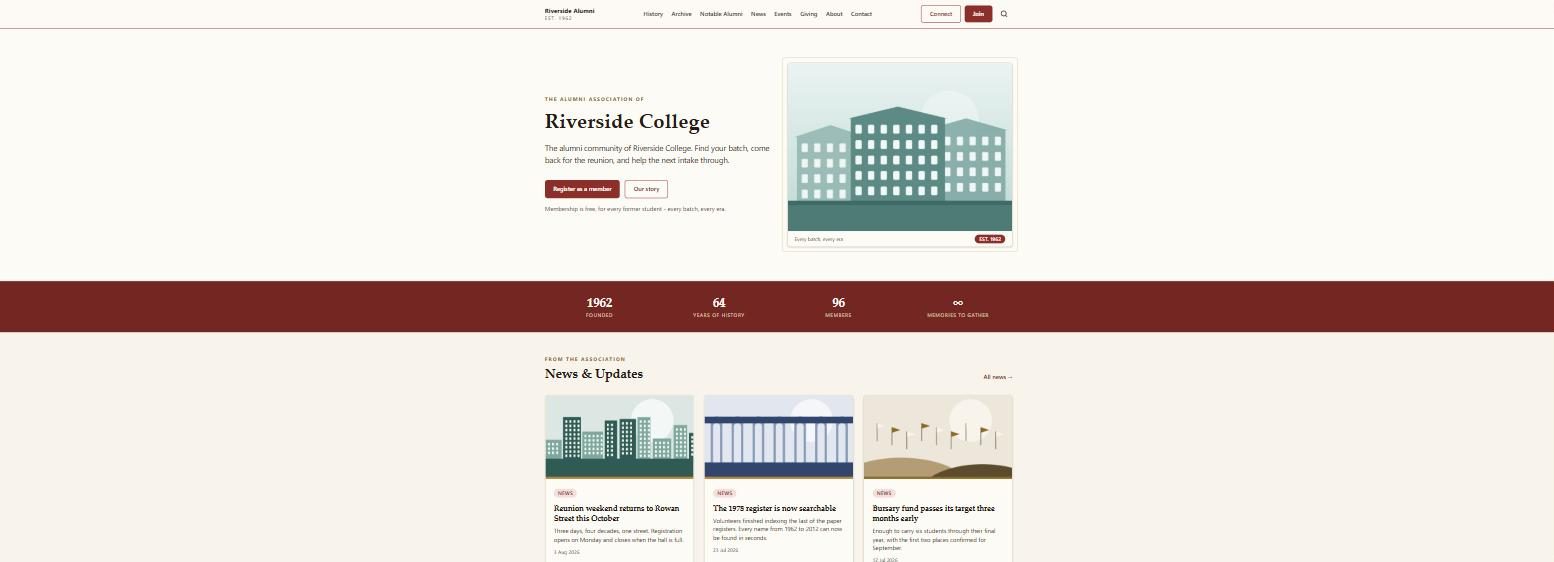
Who owns what, once it is live
Alumni relations owns
- Approving registrations against your own records
- Events, RSVPs and the attendance export
- Giving campaigns and the annual fund page
- Mentoring rounds and capacity limits
- News, newsletters and the archive
IT or the web team owns
- The one-off install: upload, database, six-screen wizard
- Hosting, the TLS certificate and the subdomain
- Applying updates when they are published
- Backups and restore testing
- Deciding whether it sits on campus or on shared hosting
Not in the box
- Single sign-on with your institutional identity provider
- A connector to your CRM or student records system
- A feed into a reporting warehouse
- A service level agreement or named account manager
When a university should buy a hosted platform instead
Higher education is where the case against us is strongest, so here it is in full rather than buried in a footnote.
Alumni records have to live inside your CRM
Almabase, for example, positions itself as a layer on top of an existing CRM, and for an advancement office already running on one, that integration is the product. AlumDeck has no CRM connector. If constituent data must flow both ways with a system of record, we are the wrong purchase.
Your security policy requires single sign-on
AlumDeck manages its own accounts, with administrator approval on every registration. If policy is that every application authenticates through the university identity provider, AlumDeck will not pass that review, and it is not a setting we can talk you into.
Procurement needs a supplier, not just a licence
We publish a support email address and that is all. There is no phone number, postal address or company registration number to put on a vendor form yet, because we do not have those to publish. Some universities cannot buy from a supplier in that position, and that is a sensible rule.
Nobody in IT will accept another application to patch
Self-hosting transfers patching, backups and uptime to you. If IT is already at capacity and will not adopt it, the honest outcome is an unpatched alumni site holding tens of thousands of personal records, which is worse than paying a subscription.
Questions from alumni offices and IT
How many alumni records can it hold?
There is no limit in the software and no per-record charge. The practical ceiling is your hosting, and ordinary cPanel shared hosting handles tens of thousands of member records without complaint. Past that, ask IT for a small virtual server: same application, same one-time licence.
Can departments, chapters and the placement cell have their own logins?
Yes, and there is no seat charge, so create as many administrator accounts as the work needs. If you require a narrower permission model, such as a chapter secretary who can edit only their own chapter's events, email hello@alumdeck.com and ask what the roles allow before you buy.
Does it replace our main website?
No, and it should not. The usual arrangement is a subdomain such as alumni.yourcollege.edu running alongside the institutional site. Logo, colours, menus, footer columns, homepage blocks and per-page SEO fields are admin settings, so it can match your brand without a developer editing templates.
Who applies security updates?
You do, or your IT team does. We publish updates and you install them, and the licence includes twelve months of updates plus email support.
This is the central trade of self-hosting. A hosted platform patches for you and charges every year. We charge once and hand you the responsibility. Neither is free; they bill in different currencies.
What happens if we outgrow AlumDeck?
Your data is in a MySQL database on your own server, so leaving is a database export rather than a request to a vendor. No exit fee, no release process, no waiting period. Changing your mind later costs you $49 of sunk software rather than a multi-year contract.
Spend the alumni budget on alumni, not on licences
$49 once, unlimited records and administrators, a year of updates and support, and every module included from the first day.
Checkout is opening shortly. Email hello@alumdeck.com with your requirements list and we will tell you honestly whether AlumDeck meets it.