An alumni fundraising website you own outright
A giving page, a campaign to point it at, and a record of who gave. AlumDeck puts all three on your own hosting for one payment of $49, so the platform stops being a line item you have to raise money to cover.
AlumDeck is not a payment processor and takes no percentage of what you raise. What that means in practice is spelled out further down.
What an alumni fundraising website has to do
Small institutions rarely fail at fundraising because the campaign page was ugly. They fail on four duller things.
Be somewhere your alumni already go
A form on a platform nobody has heard of, linked from one email, converts badly. A giving page inside the site people already visit for news, photographs and reunion dates does better, because the ask arrives with twenty years of context around it.
Ask for one thing
A bursary for two students. A roof. Lab equipment. A single concrete goal raises more than a general fund, and it lets you report back with a fact instead of a feeling.
Remember who gave
The most expensive mistake in alumni fundraising is losing the record. Next year's appeal has to know who gave, who said not this time, and who quietly gives every year without being asked. On one volunteer's laptop, that record disappears at the next handover.
Cost less than it raises
A platform at $3,000 a year is rational for a university raising six figures. For an association raising $4,000 for a bursary, the software eats the campaign. That gap is why AlumDeck exists.
The campaign lives on the site, not beside it
AlumDeck gives you a public alumni website with a members area behind it, so the giving page sits in the same navigation as the news, the reunion and the archive. The people who never log in still see the appeal.
The third news item on that homepage is a bursary fund reporting that it hit its target early, which is exactly the follow-up that makes next year's ask easier.
See more screenshots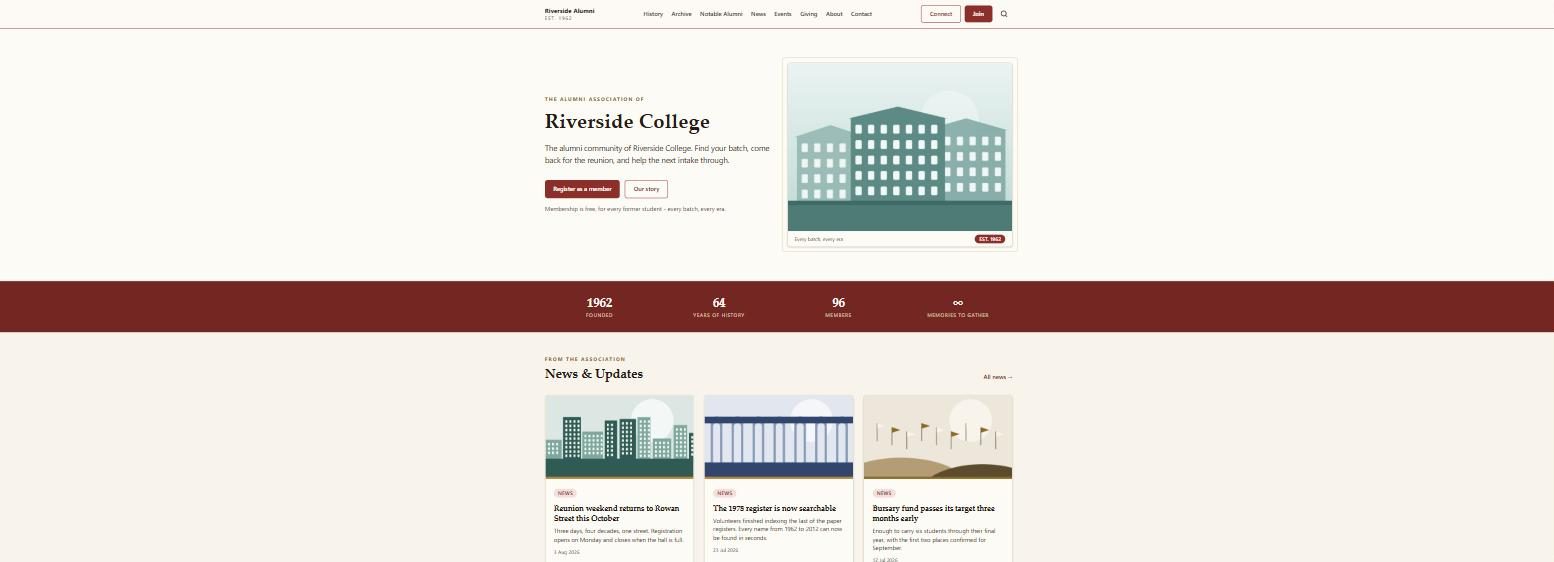
The parts of AlumDeck a campaign uses
Fundraising is not a single module. It borrows from most of the site, and all of it is in the one licence.
- Giving pages and campaigns. A branded donation page for each appeal, and a record of donations you can export.
- The alumni directory. Searchable by batch year, city, country, profession and employer, so a class gift can be aimed at one class.
- Newsletters. The ask and the reminder, sent from the same system that holds the list.
- Events with RSVP. A fundraising dinner or a jubilee reunion, which is often where the largest gifts are actually agreed.
- News. Where you report back on what the money did, which decides whether next year's appeal works.
- Committee pages and verification. Named people asking, and a donor list made of people you can identify.
There is no add-on store. Giving is not a premium module held back for a higher tier, because there is no higher tier.
Running a giving day on your own site
A first campaign takes an afternoon to set up and about three weeks to run. This is the order that works.
1. Pick one finishable thing
Name the project, price it honestly, set a target you can hit. A target that is reached is a story; a target that is missed is a reason not to try again next year.
2. Clean the list before you write a word
Missing emails, duplicate records and people who left under a different surname cost you more than the wording of the appeal ever will.
3. Build the giving page
One page, one ask, one number. What the money buys, who it helps, when it closes. Put the committee's names underneath so the reader knows who is asking.
4. Send the ask, then one reminder
Email the list, then send a single reminder near the closing date. Most gifts arrive in the first 48 hours and the last 48 hours, and almost none in between.
5. Report back within a week of closing
Say what was raised, thank donors by name where they allow it, and show what happens next. Almost everyone skips this, and it is what makes the second campaign easier than the first.
Where AlumDeck stops
If you are comparing this with a platform costing thousands a year, here is the gap, described by us rather than discovered by you.
We are not a payment processor
AlumDeck gives you the giving pages, the campaign and the record of what came in. It does not take money on your behalf, hold funds or sit between you and your bank, and no percentage of anything reaches us.
How money actually arrives stays as it is today, whether that is your institution's payment page, a transfer, a standing order or a cheque at a reunion. Before you buy, tell us how you take money now and we will say plainly how it fits.
It is not a development office CRM
No wealth screening, no prospect scoring, no moves management. If your institution employs someone whose job title contains the word advancement, they will want tools AlumDeck does not have. It also does no tax receipting, because those rules differ in every country.
The server is yours
Backups, security updates and uptime are your responsibility, on the day of a giving day as much as any other. For some institutions that alone is worth a subscription to somebody else, and we would rather you knew before the invoice than after.
What institutions ask about fundraising
Does AlumDeck take a percentage of donations?
No. The licence is $49 once per installation and that is the entire cost of the software. There is no platform fee, no per-transaction cut and no charge that scales with how well your campaign does.
How many donors and donations can it hold?
There is no limit and no per-record charge. Some hosted platforms tier by contact count or bill roughly ten cents per record per year, which is the pricing model AlumDeck was built to avoid.
Can we run several campaigns at once?
Yes, each with its own giving page. For a first campaign we would still run one at a time, because two asks in the same month usually produce less than one clear ask.
We have no donor list at all. Where do we start?
With the directory, not the giving page. Open registration, verify the people who join, and let the list build for a few months before you ask anybody for money. If you are starting the association itself, the guide to starting an alumni association covers the order to do things in.
Is our donor data visible to you?
No. AlumDeck runs on your server and your database. We have no copy, no access and no dashboard showing what you raised, and the software does not phone home.
What does it cost in year three?
Nothing, unless you want new versions. The licence is perpetual, so the site keeps running with no renewal. Renewing buys another year of updates and support, next to the several thousand a year a hosted platform would still be charging.
Raise money for the bursary, not for the software
Giving pages, campaigns, a donor record and the alumni site around them, for one payment of $49 per installation with unlimited records.
Not sure it fits how you take payments? Email hello@alumdeck.com with what you use now and we will give you a straight answer.