A class reunion website that outlives the reunion
An event page with the details on it, RSVPs you can count, and a directory by batch year so the class can still find each other in five years. One payment of $49, on your own hosting.
Most committees rebuild the same thing every five years and lose the list in between. This is the version that survives the handover.
What a reunion website has to do
Four jobs, and a group chat only really does the second one.
Find the people who are missing
Every class has a core of thirty people who are easy to reach and a long tail of everyone else. The long tail is where the good stories are, and a public page that turns up in a search does more of that work than any amount of messaging.
Say the details once, somewhere they stay put
Date, venue, time, cost, who to ask. If that only exists in a chat thread, it will be asked for again every week until the night, and the answers drift as they get retold.
Count heads honestly
The hall has a capacity and the caterer needs a number. Sixty people saying they will probably come is not a number. An RSVP list with a limit on it is.
Leave something behind
The reunion is one evening. The list of everyone who came, with current email addresses, is worth more, and it is what most committees throw away.
One page per reunion, all of them in one place
AlumDeck lists upcoming events with dates and venues, keeps past events in their own section, and gives every reunion its own page. Annual meets, chapter evenings and jubilee reunions share one module.
A real install with real content in it. The reunion weekend and the chapter evening are ordinary event records, not a mockup.
See more screenshots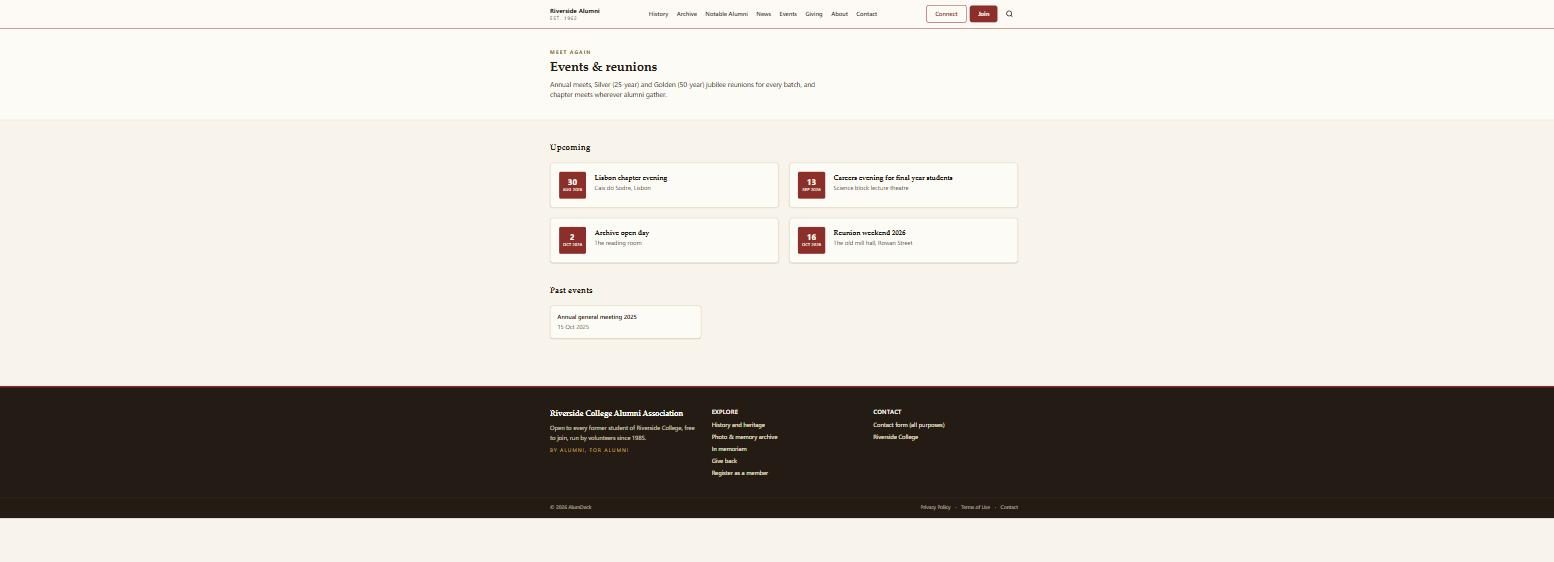
The parts a reunion actually uses
A reunion borrows from most of the site, and all of it is in the one licence.
- Events with RSVP and capacity. A page per reunion, a limit that stops you promising the hall more people than it holds, and an attendance list you can export.
- Batch and class years. Every member record carries the year they left, so the directory filters to one class in a click.
- The alumni directory. Searchable by name, batch year, city, country, profession and employer, which is how people who lost touch in 1998 find each other.
- Registration with verification. Anyone can ask to join and a human approves them, so nobody wanders into your class list uninvited.
- Photo galleries by era. The photographs from the night, and the ones from the year everyone wants to see again.
- News, newsletters and giving pages. The announcement, the reminder, the write-up, and somewhere for a class gift.
Planning a reunion on it, in order
Roughly nine months from first meeting to the night. The website earns its keep from about month one, long before the details are settled.
1. Put the page up before you know everything
A page saying the class of 1998 is meeting next autumn, venue to be confirmed, with a way to register interest, beats a perfect page in June. It starts collecting the people you were going to chase.
2. Open registration and verify as you go
Let people register on the site rather than replying to a message, and approve each one against your records. Half an hour a week rebuilds a class list nobody has held for twenty years.
3. Search for the gaps
Filter the directory to the batch year and compare it against the old register. Every missing name is a person to ask about at the next meeting.
4. Set the capacity when you book the venue
Put the hall's real capacity on the event the day you book it. That is an easier conversation now than the week before, when the room is full.
5. Invite, then send one reminder
Newsletter to the class, then one reminder three weeks out for those who have not replied. Chase the maybes by name; that is where your last fifteen attendees come from.
6. Close RSVPs, then publish the photographs
Export the list for the caterer before the cut-off. Within a week, put the pictures in a gallery and write a short news post, while people still care.
When AlumDeck is the wrong tool for a reunion
It is a $49 licence, so the failure mode is buying it for a job it was not built for.
It is not a ticketing platform
No seat maps, no barcoded tickets, no name badge design and no door scanning. AlumDeck records who is coming, with a capacity limit and an exportable list. For a black-tie dinner with allocated tables, use a ticketing platform for the evening and AlumDeck for everything around it.
It does not take the ticket money
We are not a payment processor and take no percentage of anything, which cuts both ways. Collecting a contribution towards dinner stays however you do it now.
One evening might not need a website
If forty people from one class are meeting in a pub and nobody intends to do it again, a free form and a group chat will do. AlumDeck earns its keep when the reunion is meant to leave an association behind it.
Somebody has to look after the server
Hosting, backups and security updates are yours. About as demanding as any small website, but not nothing, and if no one will own it, pay for a hosted service.
What reunion committees ask
Can we use it for one reunion and nothing else?
You can, and $49 once for a site you keep is cheaper than most alternatives for a single event. It is better value if you keep it running, because the licence is perpetual and the same site can hold the next reunion with nothing further to pay.
How do we stop more people saying yes than the hall holds?
Set a capacity on the event. RSVPs are counted against it, so you can see where you are rather than guessing from replies scattered across messages, and you export the final list for the caterer.
Can we run a separate page for each class?
Every member record carries a batch year, so the directory filters to a single class in one click, and each reunion is its own event page with its own RSVP list. That is usually what people mean by a class page, and it stays up to date on its own.
How do we find classmates nobody has heard from?
Two ways, and both are slow. A public alumni site gets found by people searching for the institution years later, which is why the page should go up early. Then the directory does the rest: someone finds a name and you get three more.
What happens to the site after the reunion?
It carries on, which is the point. The class list, the photographs and the contact details stay in your own database, and the next committee inherits a working site instead of starting again.
Is $49 really the whole price?
For one installation, yes, including a year of updates and support. Unlimited attendees, no per-record fee and no add-on store. You bring hosting, from about $3 a month, and a domain.
Turn one evening into a class that stays in touch
An event page, RSVPs with a real capacity, and a batch-year directory that is still there at the next reunion. $49 once, on your own hosting.
Planning something specific? Email hello@alumdeck.com and we will tell you whether this fits before you spend anything.